TIPS Re-Boot

Along with starting up my blog again, I am revisiting the concept of blogging TIPS for new writers and others who find them useful. Eventually these TIPS will be collected and made available as a separate document.

The writing group I’m in accepts writers of all levels. This can include teenagers who’ve decide they want to be a poet or adults who have decided they have a story to tell to septuagenarians who either wish to leave their sage advice behind or write that racy love story/mystery/ science fantasy they’ve always wanted to write.  Any of the above people can be new to writing, so we often find ourselves starting at the beginning with our advice, or even fundamental explanations.

One time we found it necessary to clear up what constitutes a paragraph. For coaches, parents, or teachers who are trying to get the concept across, here’s a simple explanation of paragraphs.

[note: in fairness to subscribers and readers, this information appeared in a post here in 2018. I’ve re-posted it in its entirety for readers’ convenience.]


3 Basic Rules for Starting New Paragraphs

Okay, so you want to write – a book, a story, an essay – whatever you want to write. But you have ZERO experience.  

You know pages have words on them, and they seem to be broken up into patterns called paragraphs, but how do you know when to do that? Here are the beginning rules. Use them to get started writing your work the way it should be written.

1. Begin a new paragraph whenever you change speakers .

This means, in dialogue, one person says something, then another one says something.

Each time this happens, each time the speaker changes, they get a new paragraph all to themselves, and their spoken words are contained in quote marks (BONUS tip there)

2. Begin a new paragraph whenever you change topic.

You begin your essay by describing the outside of your house. Then you want to move on to describing the inside of it. Make a new paragraph for the inside description. When you want to describe what the back yard looks like, that is another new paragraph.

3. Begin a new paragraph when it feels like one is needed.

This can be for a pause, a change of direction in the action, or just to change theme or thought, much like a change of topic.

You may have spent some time describing how you felt when the ambulance arrived. Then the EMT has you move into the ambulance, and you need to describe how you felt – maybe more physically than emotionally -, and what the inside of the ambulance looked like.

The arrival is one paragraph, the move into the ambulance is a second, and the description of the interior is a third.

Most of all, watch for these things in your reading. As you identify them in what you read, it will be easier for you to remember to use these tips in your writing.


‘ta
TIP ~ INKAS ~ #2

Moving on to the next group of INKAS, we’re going to look at Children’s Story and Children’s Story with Illustrations.


ChildStryNu


It was kind of fun, if a little strange, discussing writing children’s stories with kids in grades 3 through 5. Generally, they took it under pretty solemn consideration. Even young writers thought it was serious business! Especially when it came to the idea listed under No. 6, that a children’s story can teach a lesson.

But, starting from the top, because I was working with lower grade school children, I had to keep them considering stories for children younger than they are. Commercially, children’s book are classified in age groups like these:

  • Board books & concept books ……. birth to 4     word count: 0 – 100 words
  • Picture books ….. 3 to 8     word count: currently 500 – 600 words or even less
  • Picture story books ….. 5 to 8 (a hard sell)     word count: 500 – 1000 words, but crossing over 750 is an automatic ‘no’ for a lot of publishers
  • Chapter books ….. 6 to 7 & 8 to 10     word count: 5000 – 20,000 for 6/7 years and older & 20,000 – 35,000 for 8/10 years old
  • Middle grade novels ….. 8 to 12     word count: 30,000 – 45,000 for contemporary stories; science fiction/fantasy can run somewhat longer
  • Tween novels ….. 10 to 14     word count: 40,000 – 55,000 for contemporary; science fiction/fantasy, somewhat longer
  • Older YA novels ….. 15 to 18 &up     word count: 40,000+   (shorter would be a novella)

Not quite a children’s category, but something to know about, is the New Adult category. This is writing for young people age 17 to mid-20s, and has the same word count parameters as the Older YA novels. 

You should also be aware that many adults enjoy reading children’s category fiction, from about Middle grade novels on up.


Source and reference: I refer you to this blog post at Write for Kids for some details on writing for each of these categories, especially if you are new to the children’s writing business.

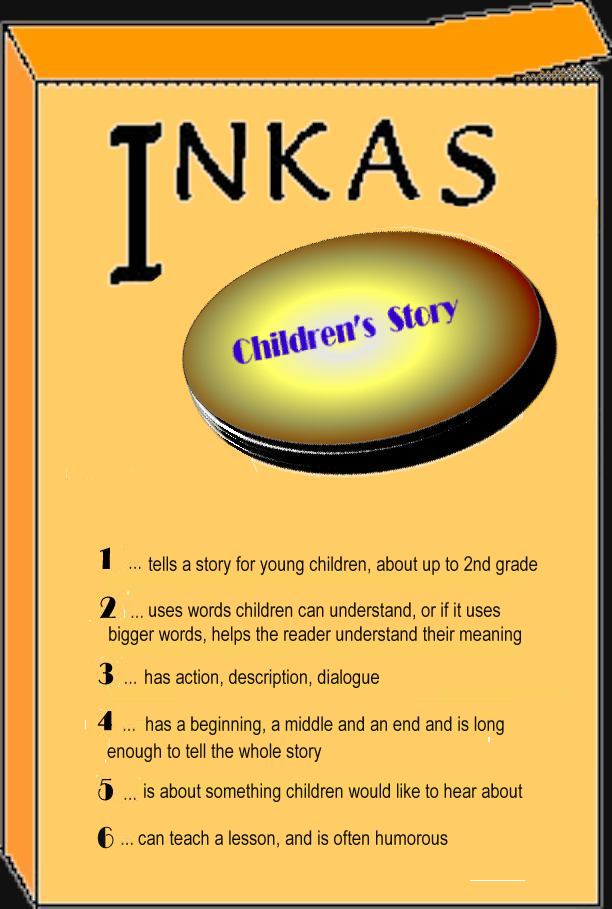
Children’s stories should always use vocabulary that children are familiar with, but there is nothing wrong with introducing new words. The trick is to provide enough story context – including the use of illustrations – to help the child figure out the the meaning.

Children’s stories have all the traits of stories in general – action, description, dialogue; being about something a child is interested in; and having a proper beginning, middle, and end while being long enough to tell the tale and still fall within word count guidelines.  One of the reasons writing for children is not as easy as some think!

One thing about Children’s stories is that they often teach a lesson, frequently using humor. But be wary. The lesson should be in the takeaway, not in a preaching moment in the story. The solution to the problem should be found by the protagonist, so that the reader can identify with the success. After all, everybody wants to be a hero.

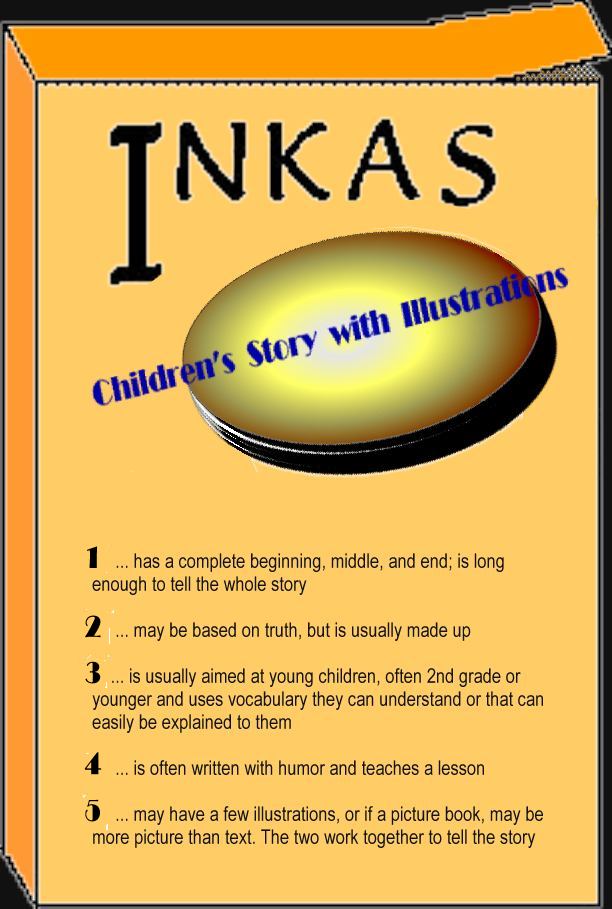
All of these things apply for Children’s Story with Illustrations as well, with just a few additions, as this INKA shows.


ChildStryIllusNu


#5 is especially important, as a lot of children’s writers have a desire to illustrate their own story. You don’t always have that opportunity, because most publishers will want to sign a known professional whose work they feel they can count on to suit your book. You might have the opportunity to express what types of illustrations you had in mind as you wrote. If you are a professional artist yourself, or a very good undiscovered one, you may be able to convince a publisher to give you a look. Because the two things work together, sometimes the illustrations are used to convey things the actual writing does not.

Every writer has stories to tell – why else would they write? The question here is, do you have a story to tell to children, maybe a story that will help them become the best sort of person they can be? Or just a story to introduce them to life on this (or another) planet?

These INKAS are only an introduction to writing for children, but maybe that introduction is all you need to start.


What we do is important…

I’ve begun editing stories for our next Off the Page anthology. Editing can be tough but fun, and it gives me a chance to expound on my own thoughts about writing.

WritersWork

I was recently reminded that when we write, although we create our own little worlds with their own little ways, each world must be consistent in how it follows its own rules. Even in magical realms, you can’t just have magic work for one being and not for another because it pleases your plot. Magic must work for both or none, or you have to provide a good explanation for this lack of consistency.  Unless, of course, you’re working on a clone of  ‘Once Upon a Time’ (which I am enjoying for the first time even as I pick on its writing.) Each story must behave according to its own parameters and logic.

The reason for this is: believe-ability. Notice I did not say ‘plausibility’. Because it isn’t about writing something that has to fit our known reality. It has to fit the reality of the world you create. If all unicorns broadcast jazz music from their horns, you might have a unicorn who doesn’t fit in because he plays country music instead.   That’s okay. His apparent aberration is an intentional part of your story.  But you couldn’t have a unicorn without a horn who could broadcast music anyway. It wouldn’t fit the rules or logic of your world. Writers who ignore this ‘rule’ end up with readers who either put down the story or throw the book at the wall- because you jarred them out of the world. You woke them up from the dream of your story, and now they can’t get back to it.

This can be even more important in books that are based on real life, because there is no ‘magical alternative’ to blame it on. It’s like stage activity in a play. If the actor goes off Stage Right on her way to the garage, and comes back onto from Stage Left carrying a tire pump, it breaks the continuity for the audience. They’ re  puzzled. Was that part of the play? How does that work? Did the actor just get turned around backstage?  Meanwhile brilliant lines and funny jokes and defining plot points are being missed as the play moves on.

You want to tell a story. You want to make a point, and you want to have attention paid to it. A writer can’t do any of these things if the writing is so inconsistent as to bump the reader out of it. And if you are writing non-fiction, you want to be taken seriously and be believed. You owe it to yourself and the reader to be provide writing that hangs together with sturdy, reasonable logic.

Writing is a tacit contract between reader and writer. What writers do is important. We first of all entertain, but we also teach, preach, counsel, and illuminate life and the human condition. We need the trust of our readers that what we say will have meaning and be worth their time to read – even if only for entertainment. We need to keep the promise we make when we put words down and ask someone to read them – that we will build a world fairly, with no shortcuts or hand-waving – and we will play fair with their imaginations to create a place they can inhabit for a time uninterrupted, without being thrown out by gross displays of mismatched behaviors or wavering parameters, until our message has been rightfully conveyed.

If readers know they can trust us, they will listen; they will read our words and consider them.  That is how ideas are cultivated. It is how hearts and minds are changed. It’s how writers change the world.

partLogo2