Comments on consistency

[excerpted from my current post on “Do You Know Where YOUR Story Is?]

  • I don’t care if all the inhabitants of a planet are legless, have a single blue eye, gills, and live in a tank where they are dependent on water, melons, and cress to live. Just don’t suddenly have their out-of-town cousin travel in on the next train walking on three legs, smoking a cigar, and using four eyes to watch me out of the back of their head. It doesn’t fit the world you built.
  • Writing romance? I know, love at first sight. But meeting a mysterious stranger, marrying them on the same page and going off to live in Saigon when you’re a celibate rocket scientist in the midst of a critical development is not going to work. That scientist, upon the entrance of the stranger, would more logically say, “Get out of my lab, I’m busy. Security!” If that romance is going to happen, it won’t be the way the writer wrote it the first time.
  • Time travel; it’s tricky. There are various types of time travel, and you have to decide what rules yours is going to follow. Does the traveler control the travel? Do they remember their own time? Can they get back? And the all-important: will anything they do in the past affect the future they left behind? Whatever rules you choose, you have to work consistently within them or readers will call foul. I certainly will.
  • Just as bad—not playing fair with the reader in a mystery. Mystery lovers want to solve the mystery along with the detective. Not letting them have the same clues the detective does isn’t fair. It’s fine if the detective doesn’t reveal what they’ve concluded from the clues—after all, you want that big reveal at the end. But you can’t hide the actual clues from the reader. (Although you can make them obscure.)

I’ve probably driven writers crazy harping on this, but it bears repeating.

No matter how unique, exotic, bizarre the world a writer creates becomes, it needs to maintain an internal consistency. Even if that world is based on being random and illogical. Then it must be consistently inconsistent.

Sometimes maintaining order in our fictional worlds is all we can maintain. Do so.

–moi

Follow-up to my previous post…

… what happened when I had my writing critiqued by my second writers group?

Click the image above to read my post at:

“Do You Know Where YOUR Story Is”

Ho! Ho! Ho!

Well, here I was, planning on finding another INKA to share, when something better to write about came along.

As noted in my previous post, t’is the Christmas season and time for gift-giving…(consider shameless plug to view my books on Amazon inserted here). It is also the time of year when results from certain book competitions are in. No, I didn’t win. But what I did receive was an interesting review of my book, Christmas House, by the judge who looked at it. Some of the comments were formulaic. That is to say, the judges were clearly provided some sort of rubric or planned answer sheet from which they chose a pre-worded response to how the book met/did not meet the established criteria. Two sections at the end of the review did allow for personal statements from the judge as to notable strengths and weaknesses. Even though Christmas House was not a prizewinner, the evaluation itself proved beneficial.

I’m proud and pleased to say that most of the comments considered my book satisfactory, and in a couple of areas–premise being one–even unique. My dialogue was appreciated, and overall, it was considered an enjoyable read. There were comments that there were some weak areas that could do with strengthening, particularly over a slow start and the roles of some secondary characters. However, the pace in general was all right, the story moved in an appropriate direction and ended leaving the reader quite satisfied. I am probably most ‘chuffed’, as the British say, over the comments on the appropriateness of the dialogue for an American English-speaking audience.

So, now, I have a predicament. I could leave the book alone, or I could go to work on an ‘expanded’ version, which would allow me to tweak and correct and amplify. I could replace the cover, which was noted as not being reflective of the story as much as it could be, and I could add some extra material such as baking and woodworking projects. And I could allow for more insight into the characters and maybe just some extra history with a reveal or two.

I could do that. I am going to have to weigh the desire to deliver the best possible story of Bret and Molly that I can against the fact that there are readers out there who have already read their tale. The story itself does not change; only more will be added, and it would be done (I hope!) with more style. A reader can read the second version after reading the first, or they can enjoy either one of them. However, if I do develop an expanded version, it will replace the edition offered currently.

This is a bit of a big decision, so if anyone has an opinion, I’d value it. Please just leave a comment.

On another Christmas-y note, I am a self-avowed Christmas nut, rather like Molly. And I am working on a Christmas epic fantasy titled Renegade Christmas. With luck, that will be finished next year and shopped around for traditional publishing. I know that means it’s a couple years before it meets the public, but that’s what I am aiming for.

In line with that, at our house, we are only partly decorated for Christmas at this point. As I was sharing with an online group, for us that means each room has at least one nativity, a Christmas tree, and a Santa, plus other sparkly Christmas decor. If you don’t believe me, just check the bathrooms!

Here are a few pictures from one Christmas some years back.

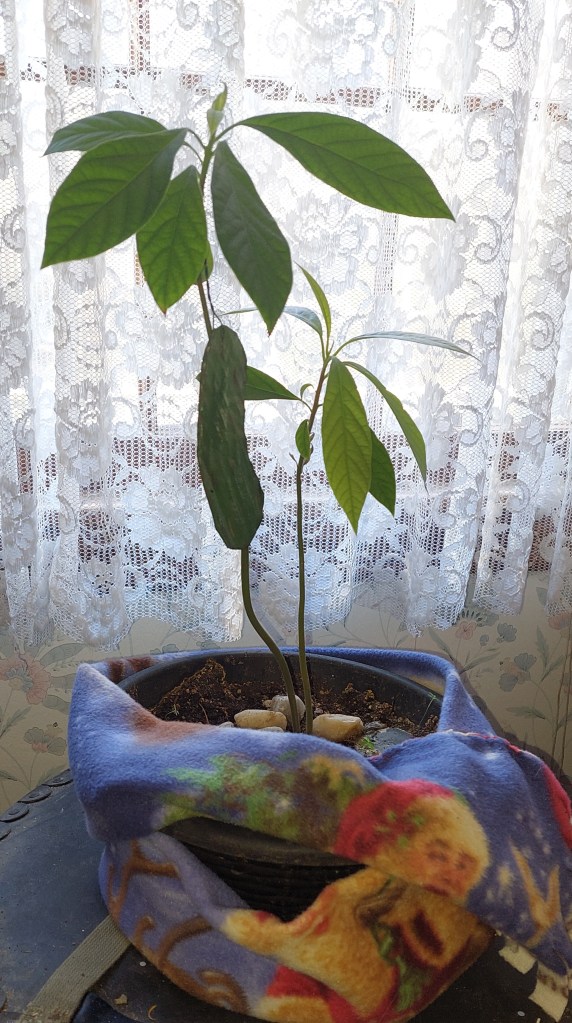
One group member in particular was amazed at people who go to such decorating and design lengths for the holiday. He remarked that his idea of Christmas decor was to drop an ornament on an avocado tree and call it a day. In tribute to him and other people who prefer restraint in their holiday decorations, I present:

Note the pickle-shaped ornament on the larger tree. The hanging of a pickle ornament on a Christmas tree is an old European tradition. The pickle is hidden in the branches, and the finder gets a prize (usually chocolate!)