TIP ~ INKAS ~ #4

A quick reminder to followers, and an introduction for new readers, INKAS are a way I created to list the essentials of certain types of writing.

inkasImage

There are roughly 20 different INKAS, and I’ve been introducing them one by one for writers who are unclear about the differences amongst them. (What are INKAS? …..  TIP ~ INKAS ~ #1) Collectively, for me, Story refers to any tale told – orally or in writing – and told in any form. It can be a true story, it can be done as prose, poetry, or in song. But breaking Story down into its different forms is necessary so that writers put the correct “ingredients” together, and also know when to break the rules a little. That’s how cooking works. You follow the recipe until you understand that type of cooking, then you experiment with other ingredients. Sometimes the cake rises, and sometimes it falls, but you’ve become a cook – or even a chef – who knows what they’re doing.

Here are links to the previous posts about specific INKAS.

Short Story …..TIP ~ INKAS ~ #1.1

Children’s Story & Children’s Story with Illustrations ….. TIP ~ INKAS ~ #2

Poetry …..  TIP ~ INKAS ~ #3


Today I want to talk about INKA #4:  Song Lyrics

songwritingINKA

Like poetry, songs express our innermost thoughts and feelings; they just do it with musical accompaniment. And sometimes the music is all there is.

Songs can tell a story or  describe a single moment hidden a person’s soul. However, song lyrics can’t be written same way as a poem. Song lyrics must go with the music, coordinating rhythm and mood so that the song makes emotional sense. Not to say a poem can’t become a song. It’s often a good place to start. But there are other considerations.

The various styles of music – country, jazz, opera, popular, show tunes – use different styles of lyrics in their songs. Some jazz songs have no specific lyrics at all but rely on improvised sounds from the performer, referred to as ‘scat’, that may or may not have included actual words. Modern hip hop combines vocal sounds – or beats – with  lyrics that are spoken rather than sung, rap. These lyrics are vastly different in both content and style from other styles.

There are even further breakdowns within the main genres. County includes bluegrass. Jazz includes blues and Motown. Opera encompasses a lighter version, operetta, and a more modern style, rock opera. Music keeps evolving, too. A writer wanting to write lyrics for a particular style needs to study that style for length, emotion, pace, and even the types of vocabulary most often used.

It only makes sense. I’ve belabored the point a bit, because it seems to be what new writers forget. If you want your writing to succeed in a given genre (musical or otherwise) you must first get to know that genre inside and out. Then, when you can’t get the sound of it out of your head, sit down to write.


Time for a commercial:      “Do You Know Where YOUR Story Is?”

Is it a germ of an idea? Is it a rough draft or work-in-progress? Is it on its way to a publisher? Writers need to keep track of their work, and knowing where you are in the process is part of it.

I’ve started a free newsletter on Substack  that will cover all aspects of Story – where it begins, where it goes, and how it gets there. Topics will delve into the purpose and value of writing groups, and the newsletter will feature guest posts from members of Off the Page & Under the Radar. the writing group I’m part of.  In addition, there will be samples of our writing, maybe even a serialized story for your entertainment.   Please take a look at “Do You Know Where YOUR Story Is?” today.


Okay, I plead Guilty. Guilty, guilty, guilty.

I’d like to think we’ve all done it. You know. Procrastinate. Put things off. Lost track of time and/or what we were doing. C’mon, you’ve done it, right? Let something slide because you got busy with other things?

Yes? No?

Okay, so maybe a year is a little much, but, yes, it’s been a year since my last post. I apologize.

To my credit, I’ve re-organized my way(s) of reaching my readers. Well, I’ve organized it. For the first time, really. It wasn’t easy. It took a lot of mulling and musing and shaking my head. And a couple of consultations with one of my sons, who also acts as my editor and sounding board for all things writing-related. To be fair, he’s one of three of my kids who can edit for me, but he’s the handiest, and maybe the easiest to talk to, because he understands how I think. He can guide me through my thoughts step-by-step better than I can myself.

I had always tried to link my communications together, re-posting and cross-posting where it wasn’t a problem, then having something unique to each platform.  But the lines would get blurred, and I’d be unsure, hesitant to post, because I wasn’t sure if I was making unnecessary duplicates or if I wasn’t offering the right posts. I thought about it a lot, but all my ideas were a little fuzzy. I couldn’t get a complete picture of what I was trying to do, let alone the best way to do it.

Finally I sat myself down at the computer and made up a table. I headed the columns with the different media sites I used, as well as a couple of sites that were primarily resources but that required as much monitoring as the others. Beneath each heading I wrote down the purpose the site served and the types of posts I wrote for it. Just doing that helped me sort out which posts needed to go where, and when and what material needed to be cross-posted. My excellent son guided me through figuring out which site would take the most effort to support – he was very much aware of my tendency to run out of steam, although he hadn’t realized how much of that was because I hadn’t nailed down what went where. Then I prioritized them by how important I felt it was to keep them current. Just writing it down clarified things and enabled me to set up a rough schedule for when and what kinds of posts to make on each site.

So, I’m starting up again. This site will have top priority, with posts going up 1-4 times a month. The format will remain the same: My books will all be displayed here, and there will be my reviews of other books. The blog will focus on varying aspects of the noveling process, and I will complete the collection of INKAS. Keep an eye out for the next one!

Here are links to the INKAS: what they are and the ones I've already covered:

What are INKAS   .....    TIP   ~ INKAS~  #1

Short Story   ....   TIP ~ INKAS ~ #1.1

Children's Story & Children's Story with Illustrations   .....    TIP ~ INKAS ~ #2

Poetry   .....    TIP ~ INKAS ~ #3

INKA #4 will be up soon: S O N G    L Y R I C S!


Smuggle and Stitch, part 2 – with samples

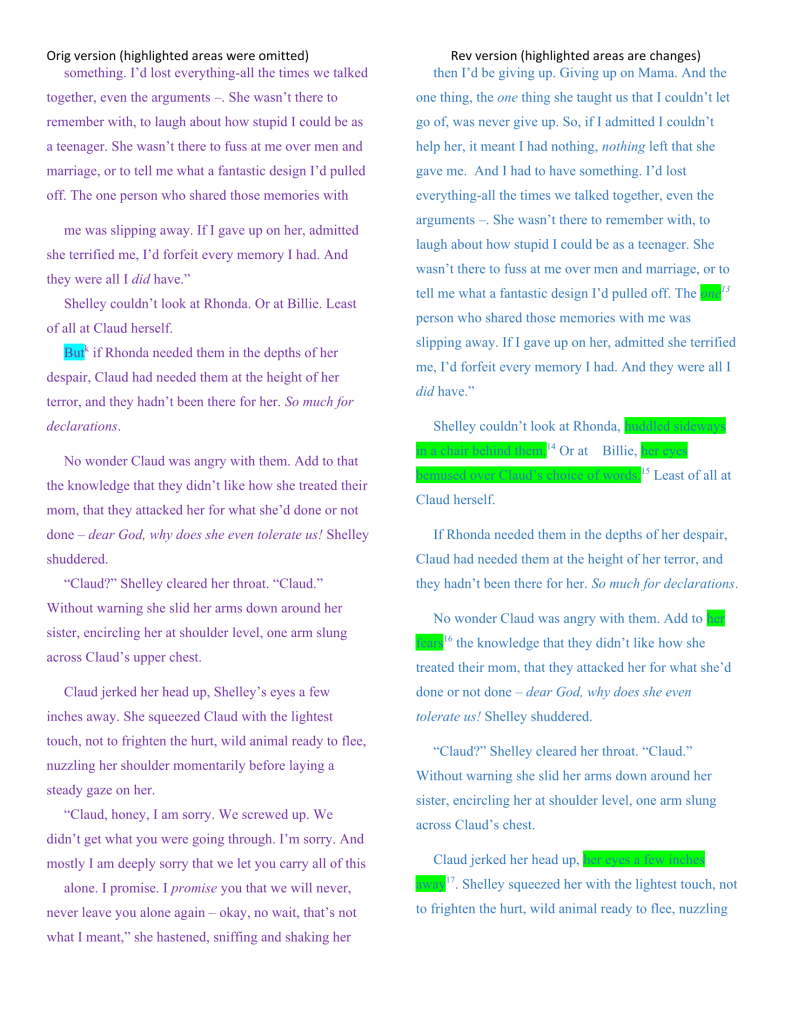
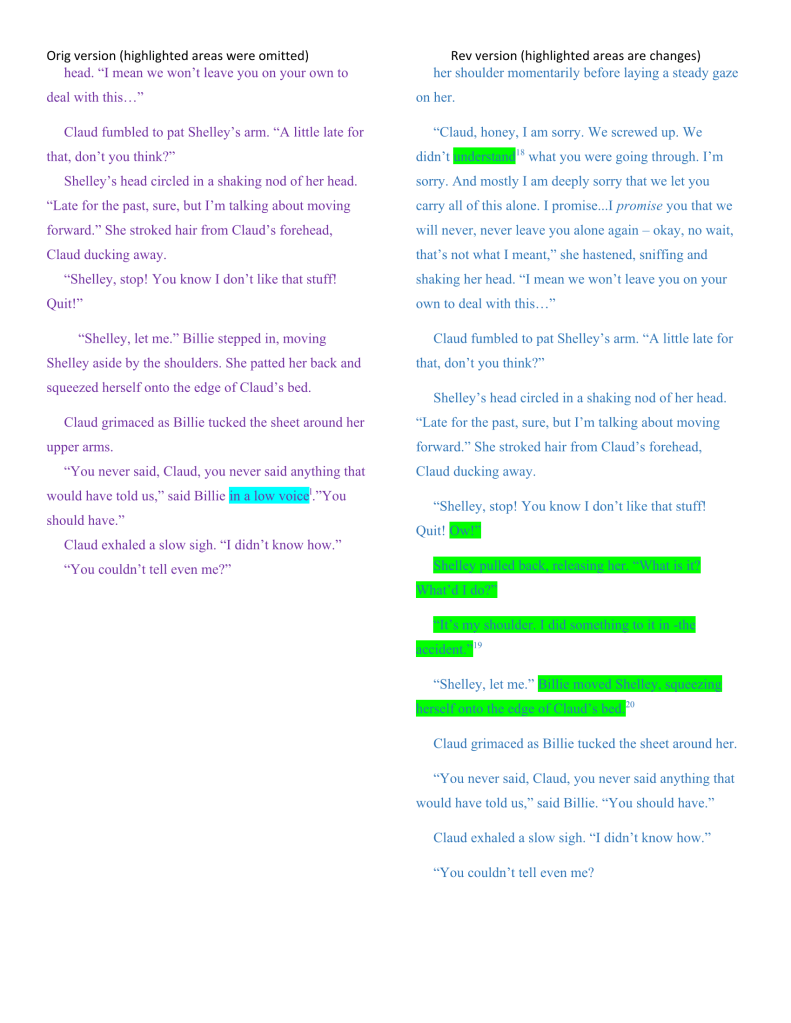
I promised I would share some examples of this type of revising. This may not be the best illustration I could offer, but I didn’t want to make things run too long. It is taken from my current work-in-progress (wip) about five sisters who set out on what may be the last road trip they will ever take together. Remembrances of their past and revelations about the present threaten their relationships and their future. You might suspect that this is a dense novel – relationships amongst five women equal 25 relationships to illuminate – and you’d be right. So part of the task is telling the whole story fully in as economic a way as possible. Which means I’m in for several passes of revisions.

FOCUSING ON THE SMUGGLE AND STITCH

In these side-by-sides samples, the Original version has blue highlights where I took out the sections that do not appear in the Revised version. The Revised version has the added/new material highlighted all in green.

This revision encompassed three tasks.

  • First, it eliminated unnecessary words. (And, of course, in compiling this post, I’ve noticed more I need to remove, but that’s for another day.)

  • Second, it smuggled in details that were important for the reader to get an accurate view of the scene, and to foreshadow, or at least drop clues to the reader about something the sisters were missing.

  • Third, it stitched in the beginning of my new material, hopefully integrating it with the original material smoothly.

In addition to what is shown here, I had to go through earlier parts of the  manuscript to smuggle in further hints and information so that this section made sense. When I make the next, full-manuscript revision, I will watch out for where my efforts did not work and what kind of fixes they require.

This may be the most difficult kind of re-writing there is. Certainly it holds up a project. But, from past experience, I can tell you it may be the most important kind there is to face down and conquer.


It may be difficult for readers to spot what I mean in these examples. This kind of coaching often works better in an interactive environment. If you have questions about what I’ve done here, or even if you disagree, please feel free to comment and we’ll have a conversation.

‘ta