I’ve posted a new column to my Substack, “Do You Know Where YOUR Story Is?” and I think followers here might be interested in it as well. It’s about writing in times of trouble, something we might all face or even be facing right now.
Click the image to read the article, and even subscribe for future ones.
I also intend to be back here with more on my novel, new posts about where I am on the current project, as well as new projects and how I manage to be part of and benefit from 2 writing groups at once.
Note: For those who are serious about being published–whether by yourself or a traditional publisher–there’s a helpful and practical site out there that specializes in articles about material pertinent to the process. Started by professional book marketer Dave Chesson, Kindlepreneur (https://kindlepreneur.com) provides technical information on publishing in basic terms that writers new to the process can understand. Today’s post draws some of its specific information from one of his own articles about the difference between a novel and a novella. For more information on that particular subject and what it can mean, click on this link, https://kindlepreneur.com/novel-vs-novella/ .
Now, about those INKAS…
Today’s INKA formats emphasize the qualities of longer forms of writing versus shorter. There’s a lot of categories characterized by their length. But the actual word count isn’t the only difference. Manuscript length–or word count– definitely affects the total product in particular ways. Fewer words mean you can’t tell as much. It also means every word must do as much work as possible. It’s one reason many writers find short stories — of any kind — more difficult than longer ones.
You can divide all writing into categories of Long and Short. There’s novels, novellas, and novelettes. There’s long stories and short stories. There’s vignettes and flash fiction. In non-fiction that is written as a narrative–such as memoir or human-interest pieces are, there are categories that differentiate by length as well. So where does the length affect come into play? As noted above, you obviously can’t tell as much with fewer words. Therefore, your writing must be tight. Words must be precise, conveying meaning without excessive adverbs or even adjectives.
Now, about those INKAS…
Today’s INKA formats emphasize the qualities of longer forms of writing versus shorter. There’s a lot of categories characterized by their length. But the actual word count isn’t the only difference. Manuscript length–or word count– definitely affects the total product in particular ways. Fewer words mean you can’t tell as much. It also means every word must do as much work as possible. It’s one reason many writers find short stories — of any kind — more difficult than longer ones.
You can divide all writing into categories of Long and Short. There’s novels, novellas, and novelettes. There’s long stories and short stories. There’s vignettes and flash fiction. In non-fiction that is written as a narrative–such as memoir or human-interest pieces are, there are categories that differentiate by length as well. So where does the length affect come into play? As noted above, you obviously can’t tell as much with fewer words. Therefore, your writing must be tight. Words must be precise, conveying meaning without excessive adverbs or even adjectives. Making A word count shortens the STORY word count.
—————————————————————–
Making A word count shortens the STORY word count.
——————————————————————————
Making each word count means you can tell more in your story. Not just in plot either. You can develop characters more fully and even handle multiple character plotlines in less space.
We’ll use novel and novella as examples of long versus short.
Think of a novel as a leisurely stroll through a well-appointed park dotted with nooks and crannies and playgrounds and places for things like chess and bocce or horseshoes. Maybe you meet a neighbor and have a short chat or start a prolonged discussion with a new friend. Then you go home and work out whether or not you want to join that political group your friend has invited you to, and you call them later in the evening to decline, wondering what ever possessed you to consider it in the first place. That’s a lot of physical and emotional territory for a simple walk, and it can have a lot of emotional complexity.
Novella, a shorter style, is more like a brief walk to the mall where you and a friend do some shopping, eat at the food court and maybe throw coins in the mall’s fountain while you discuss how to fix your respective romantic issues. An enjoyable outing, but faster-paced, covering less territory, and over quicker than the outing described above.
How does all this come into play when you are writing?
I’ve seen writers who spent talent and words creating an extensive novel on the events of one day. I’ve also seen writers who tried to encompass multiple lives and decades in a long story, which is even shorter than a novelette (which in turn is shorter than a novella). Whether you do it before you write a single word or when you begin your revisions, you need to choose an appropriate length for what you are trying to accomplish with your writing. Consider these questions.
How (and for how long) do you want to hold your readers’ attention?
How many characters’ stories do you need to include to make your point, whether it be to inform or to entertain?
How enmeshed in your characters and their world do you want your audience to be?
Does your writing style tend toward flowing words and conversational tone? Or is it more to-the-point and informative?
What will your publishing media be? Digital or hard-copy magazine? Self- or traditionally published book? Web content?
All of these are contributing factors to what length you choose to write to.
And then there’s the day when you simply sit down with a good idea and begin to write, not knowing exactly where the story is going or how long it will be, but it’s a story you feel you must write.
There is one important thing to remember. Write your story whatever length it takes to tell it completely. Writers often begin a short story only to find out it needs to be a novel, or it grows into one all on its own. Occasionally they write a novel that can’t be supported by its content; it needs to be a long story or a novella. So, write it out as long as it takes. When you’re finished, if you really want the length to be something different, then it is up to you as the writer to revise/edit the piece to fit your needs, still keeping the essence of what you were trying to say.
The table below summarizes INKAs for various lengths of writing. I began writing INKAS when I worked with young students, and the INKAS were based on the requirements of a city-wide writing contest. Because new writers come in all shapes and sizes, I’ve kept the elements in INKAS pretty basic. Unfortunately, that makes for repetition, but it also means you can spot the similarities and differences quickly.
Well, here I was, planning on finding another INKA to share, when something better to write about came along.
As noted in my previous post, t’is the Christmas season and time for gift-giving…(consider shameless plug to view my books on Amazon inserted here). It is also the time of year when results from certain book competitions are in. No, I didn’t win. But what I did receive was an interesting review of my book, Christmas House, by the judge who looked at it. Some of the comments were formulaic. That is to say, the judges were clearly provided some sort of rubric or planned answer sheet from which they chose a pre-worded response to how the book met/did not meet the established criteria. Two sections at the end of the review did allow for personal statements from the judge as to notable strengths and weaknesses. Even though Christmas House was not a prizewinner, the evaluation itself proved beneficial.
I’m proud and pleased to say that most of the comments considered my book satisfactory, and in a couple of areas–premise being one–even unique. My dialogue was appreciated, and overall, it was considered an enjoyable read. There were comments that there were some weak areas that could do with strengthening, particularly over a slow start and the roles of some secondary characters. However, the pace in general was all right, the story moved in an appropriate direction and ended leaving the reader quite satisfied. I am probably most ‘chuffed’, as the British say, over the comments on the appropriateness of the dialogue for an American English-speaking audience.
So, now, I have a predicament. I could leave the book alone, or I could go to work on an ‘expanded’ version, which would allow me to tweak and correct and amplify. I could replace the cover, which was noted as not being reflective of the story as much as it could be, and I could add some extra material such as baking and woodworking projects. And I could allow for more insight into the characters and maybe just some extra history with a reveal or two.
I could do that. I am going to have to weigh the desire to deliver the best possible story of Bret and Molly that I can against the fact that there are readers out there who have already read their tale. The story itself does not change; only more will be added, and it would be done (I hope!) with more style. A reader can read the second version after reading the first, or they can enjoy either one of them. However, if I do develop an expanded version, it will replace the edition offered currently.
This is a bit of a big decision, so if anyone has an opinion, I’d value it. Please just leave a comment.
On another Christmas-y note, I am a self-avowed Christmas nut, rather like Molly. And I am working on a Christmas epic fantasy titled Renegade Christmas. With luck, that will be finished next year and shopped around for traditional publishing. I know that means it’s a couple years before it meets the public, but that’s what I am aiming for.
In line with that, at our house, we are only partly decorated for Christmas at this point. As I was sharing with an online group, for us that means each room has at least one nativity, a Christmas tree, and a Santa, plus other sparkly Christmas decor. If you don’t believe me, just check the bathrooms!
Here are a few pictures from one Christmas some years back.
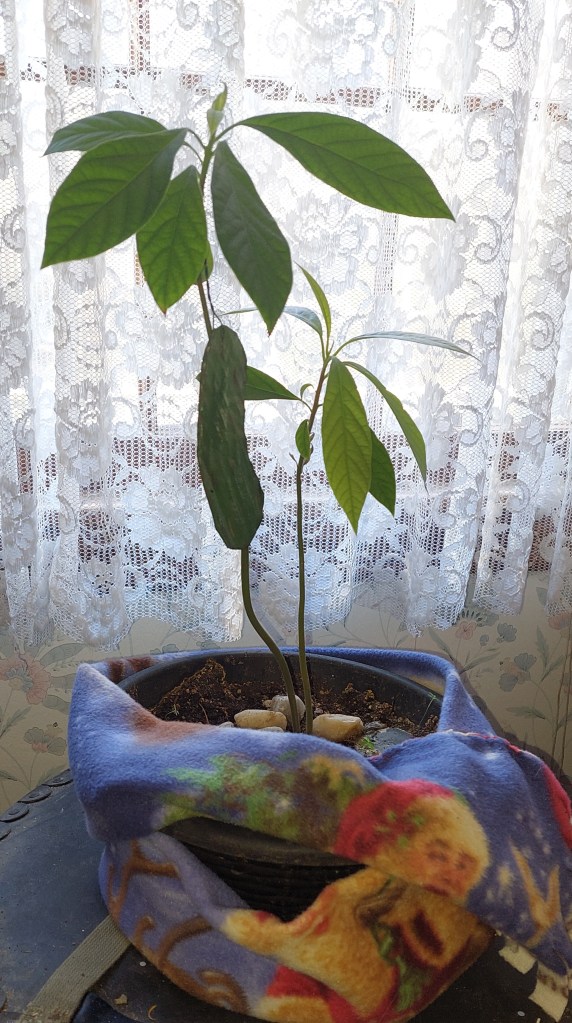
One group member in particular was amazed at people who go to such decorating and design lengths for the holiday. He remarked that his idea of Christmas decor was to drop an ornament on an avocado tree and call it a day. In tribute to him and other people who prefer restraint in their holiday decorations, I present:
Note the pickle-shaped ornament on the larger tree. The hanging of a pickle ornament on a Christmas tree is an old European tradition. The pickle is hidden in the branches, and the finder gets a prize (usually chocolate!)



 Finding Robin's Story